Fitbit Air Review 2026: Google's $99 Screenless Tracker — Is It Worth It?
Fitbit Air Review 2026: Google's $99 Screenless Tracker â Is It Worth It?
Google just reinvented the Fitbit â and they did it by removing the screen entirely. The Fitbit Air is a 5.2g pebble that clips onto interchangeable bands, tracks your health around the clock, detects AFib without a subscription, and costs $99.99. It's either the most sensible fitness tracker of 2026, or the most confusing â depending entirely on what you want from a wearable.
We've gone through every spec, every sensor, every software feature, and every tradeoff so you don't have to. Here's our complete Fitbit Air review for 2026.
Quick Verdict
- Fitbit Air launched May 7, 2026 â shipping May 26 â at $99.99 / £84.99.
- At 5.2g, it's one of the lightest fitness trackers ever made.
- FDA-cleared AFib detection is included free â no subscription needed.
- Google Health Coach (Gemini AI) is $9.99/mo â optional, not required.
- Comes with a 3-month Google Health Premium trial.
- Works on both iOS and Android â mrare for a Google product.
Key Specs at a Glance
Design & Build Quality
The Fitbit Air's most striking feature is the one it lacks: a screen. The "pebble" â Google's internal name for the sensor module â is a smooth, oval disc measuring just 8.3mm thin and weighing 5.2g. It doesn't have a display, no buttons, and no haptic buzz. It's purely a sensor platform.
The pebble clips into Fitbit Air-compatible bands via a proprietary sliding mechanism. The included Performance Loop is a textured fabric band that sits flat against the wrist â comfortable enough for 24/7 wear. The Active Band (silicone, sold separately) is better for swimming and intense training. The Elevated Modern Band (sold separately) is positioned as the premium option for professional settings.
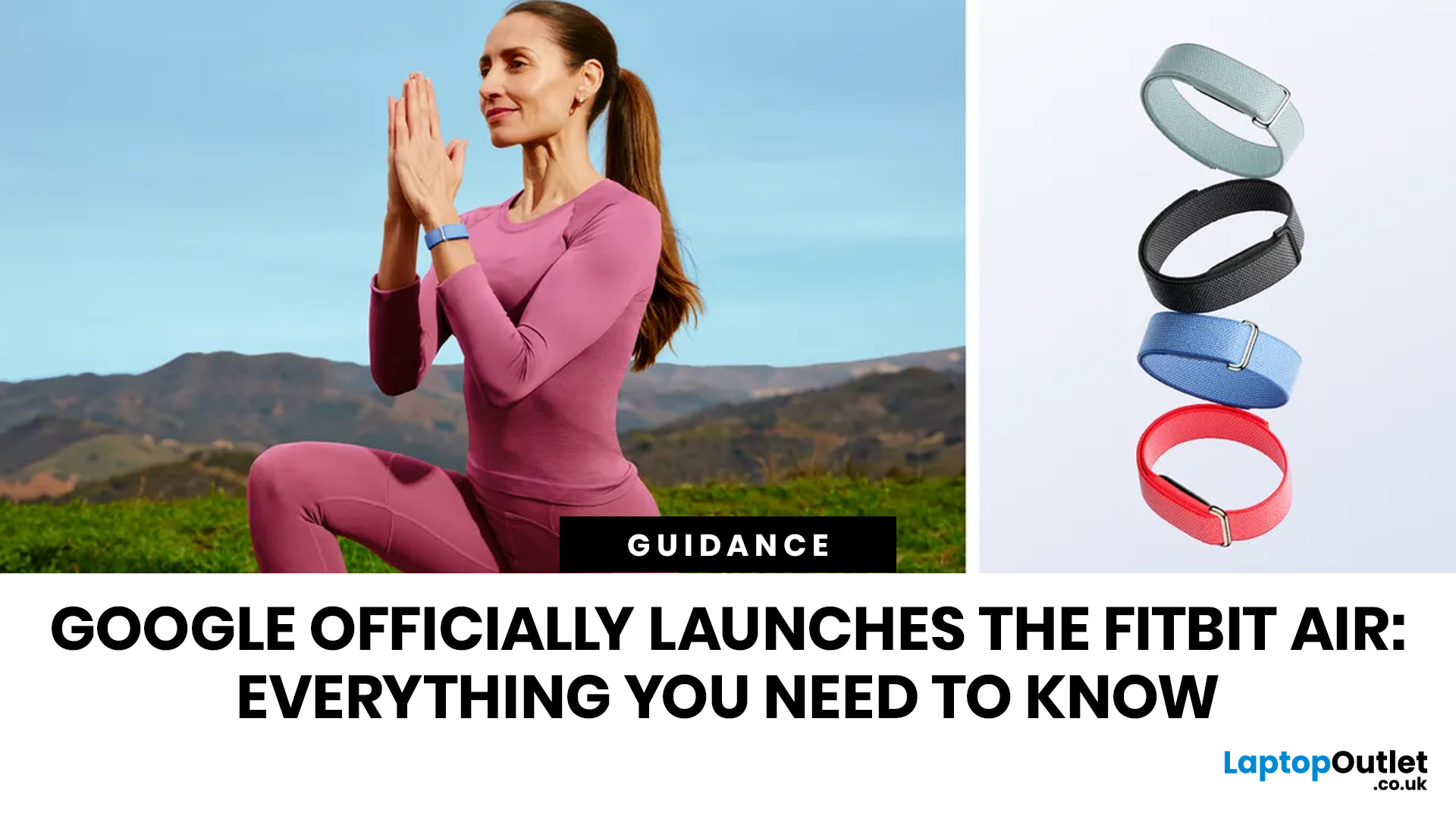
The four color options â Obsidian, Fog, Lavender, and Berry â cover the spectrum from understated to expressive. Obsidian is the safe all-rounder. Lavender and Berry are bold enough to make a statement. Fog is the minimalist's choice.

The Fitbit Air pebble in Obsidian â 8.3mm thin, with no screen, no buttons, and a ceramic-smooth finish.
At 12g total weight with the band, the Fitbit Air is extraordinarily light. For context, the Whoop 5.0 runs around 28g. The Amazfit Helio is similar to Whoop. The Fitbit Air is genuinely easier to forget you're wearing â which matters for sleep tracking accuracy.
Sensors & Health Tracking
For a $99 device with no screen, the Fitbit Air packs an impressive sensor array:
- Optical Heart Rate sensor â 24/7 continuous monitoring
- SpO2 (Blood Oxygen) â passive overnight monitoring
- Skin Temperature sensor â tracks nightly variation, useful for illness detection and cycle tracking
- 3-axis accelerometer â step counting, activity detection, sleep stage movement
- Gyroscope â orientation and more precise movement data
The sensor package enables: 24/7 heart rate tracking, heart rate variability (HRV), SpO2 monitoring, sleep stage detection (light, deep, REM), daily readiness score, cardio load tracking, and FDA-cleared AFib irregular rhythm detection.
That last point deserves emphasis. AFib detection on the Fitbit Air is FDA-cleared and included free with the device. On the Whoop 5.0, AFib monitoring requires upgrading to the Medical Grade subscription at $359/year â an extra $160 on top of the base plan. For anyone with cardiac health concerns, this alone could justify the Fitbit Air purchase.
The one caveat: Fitbit Air does not have built-in GPS. Workouts that require route tracking use your phone's GPS via the Google Health app. This is the same limitation as Whoop 5.0, so it's not a disadvantage relative to the main competitor but if you run without your phone, it's worth knowing.
Battery Life & Charging
Fitbit Air delivers 7 days of battery life â two days more than the Whoop 5.0's 5-day claim. In practice, 7 days with continuous HR, SpO2, and sleep tracking is excellent.
The fast charge is the headline feature here: 5 minutes of charging gives you a full day of use. Plug in while you shower, unplug when you're done â you'll never really need to think about charging the Fitbit Air. The charger is USB-C magnetic, which is vastly more convenient than Whoop's proprietary battery pack.

The Google Health app replaces the legacy Fitbit app on May 19, 2026 â a cleaner interface with Gemini AI integration.
Software & App: Google Health
The Fitbit Air pairs with the Google Health app, which officially replaces the legacy Fitbit app on May 19, 2026 â a week before the device ships. Google Health is a significant visual and functional upgrade from the old Fitbit interface. Metrics are clearly laid out, historical data is easy to navigate, and the app works seamlessly on both Android and iOS â an important point, because many Google products don't extend this cross-platform courtesy.
The optional Google Health Coach, powered by Gemini AI, is available as a subscription at $9.99/month or $99/year. It provides personalized recommendations based on your health data â when to train harder, when to rest, how your sleep quality affects your readiness. Every Fitbit Air purchase includes a 3-month Google Health Premium trial, so you can evaluate whether the AI coaching is worth the ongoing cost before committing.
Critically: the core functionality â heart rate, sleep, AFib, readiness â is available for free. The AI coaching layer is an upsell, not a requirement. This is a fundamentally different model from Whoop, where the subscription is mandatory from day one.
What's in the Box
| Item | Included |
|---|---|
| Fitbit Air pebble sensor | Yes |
| Performance Loop band (S/L size) | Yes |
| USB-C magnetic charger cable | Yes |
| 3-month Google Health Premium trial | Yes |
| Active Band (silicone) | Sold separately |
| Elevated Modern Band (premium) | Sold separately |
| Power brick / wall adapter | No |
Pros & Cons
Pros
- Incredibly light at 5.2g / 12g with band
- FDA-cleared AFib detection â free, no subscription
- 7-day battery with 5-min fast charge
- USB-C magnetic charging
- Works on iOS AND Android
- Skin temperature sensor included
- 3-month premium trial included
- Competitive $99.99 price
- No mandatory subscription
Cons
- No built-in GPS (phone GPS only)
- No screen or notifications
- Lower HR sampling rate than Whoop
- Proprietary band system (adapter coming from EverythingStraps)
- Google Health app still maturing
- AI coaching costs extra $9.99/mo
Value: How Does It Compare at $99.99?
The Fitbit Air's value proposition is exceptional when you look at the total cost of ownership. At $99.99 with no mandatory subscription, you're getting AFib detection, skin temperature, 7-day battery, and Google Health integration â features that would cost $359/year on Whoop's Medical Grade plan.
Even if you add the optional AI coaching ($99/year), your total first-year cost is $198.99 â one dollar less than a single year of Whoop's basic subscription, for a device you own outright. If you don't want the AI coaching, you're at $99.99 forever.

Fitbit Air works just as well in the gym as it does in the boardroom â the screenless design adapts to any context.
Who Is the Fitbit Air For?
The Fitbit Air is the right choice if:
- You want comprehensive health monitoring without a mandatory subscription
- AFib detection matters to you (personal or family history of cardiac issues)
- You're migrating from an older Fitbit or a Whoop and want to cut costs
- You care about weight â at 12g total, nothing else comes close
- You use both Android and iOS across different devices
- You want AI coaching that learns from your actual data
The Fitbit Air is not ideal if you need built-in GPS, want glanceable notifications on your wrist, or require the highest possible HR sampling rate for elite athletic training.
A Note for Whoop Users
If you're currently on Whoop and considering the switch to Fitbit Air, the strap ecosystem is a real consideration. You've likely invested in Whoop bands â SportsFlex, nylon, silicone â that fit perfectly and feel great. EverythingStraps is launching a Fitbit Air à Whoop adapter that lets you mount the Fitbit Air pebble onto your existing Whoop straps. No need to start your band collection over.
The Fitbit Air is the best value-per-dollar health tracker of 2026. FDA-cleared AFib detection at $99.99 with no mandatory subscription is genuinely remarkable. The lightweight design and fast charge make it effortless to wear 24/7. The only meaningful limitations â no GPS, lower HR sampling than Whoop â are manageable for most users. Highly recommended.
Coming from Whoop? Don't Ditch Your Straps.
Pre-order the EverythingStraps Fitbit Air à Whoop adapter and keep the bands you love.
Pre-Order the Adapter Browse All Products